Your interests, and only yours.
We find the right space, negotiate the best economics, and protect your interests on every lease term — aligned only to you, never to a building.
What Tenant Representation means at RDE
RDE Advisors represents tenants in office, retail, and industrial leasing transactions in New York City and across the nation.
We start with your headcount, timeline, and must-haves, then canvass the full market — direct listings, subleases, and off-market space — using Alliance Group comps to give you an honest read on pricing.
We run competitive processes that change landlord behavior. Our only alignment is to you.
A methodical process.
Typically 9 to 18 months, from engagement to move-in.
We start with diligence, not listings. Before touring a single space, we translate your headcount scenarios, culture, budget, and timing into a written occupancy strategy that drives every decision downstream.
- Representation agreement
- Select team members
- Draft project budget
- Develop occupancy strategy
We survey the whole market — not just what's listed — inspect the real contenders, and narrow to a short-list backed by test-fits, so you compare on facts, not floor-plates.
- Prepare space report
- Select & inspect alternatives
- Prepare short-list of options
- Conduct test-fits
We run competitive processes, read the landlords, and negotiate the economics that actually move your net effective rent — modeling every option side by side before you sign.
- Draft & send proposals/RFPs
- Negotiate terms
- Analyze financial models
- Select final site & execute LOI
- Negotiate & sign lease
Our work doesn't end at signature. We manage the buildout — test-fit through construction documents to construction — right up to the day your team moves in.
- Finalize schematic design (test-fit)
- Design development
- Construction documents
- Construction
- Move-in
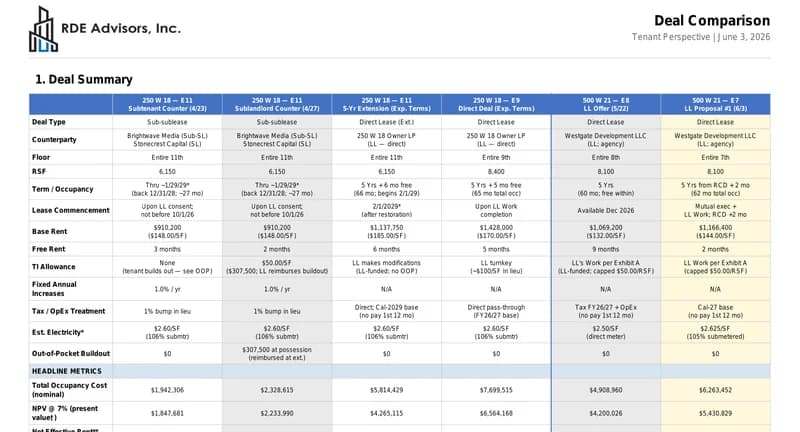
Representative samples — names, figures, and addresses are illustrative.
What we negotiate for you.
In Transaction Management, we push on every lever that affects your total occupancy cost and operational flexibility.
What are the comps in the building and neighborhood? How long has the space been sitting vacant? There are several different ways to determine and negotiate a fair base rent.
All landlords will offer a rent abatement. We understand how much to ask for to help mitigate the effects of potential double rent and construction downtime and to help lower your net effective rent.
Your rent can increase based on actual expenses of operating the building, CPI or fixed annual increases. The operating expense can easily equate to 5%–15% of your total obligation. We structure the deal to keep it as low as possible.
Taxes typically go up and you are responsible for the proportionate share of increases. We negotiate to have the right base year (and more) so that your tax responsibility is as low as possible.
Landlords have a "rubber ruler" and can quote any measurement they want on a space. Make sure that they are using a market loss factor or else you are paying on square footage that you shouldn't be.
Who is responsible for maintaining the HVAC unit throughout the lease? Are there overtime costs after 6pm? These costs rack up and can be a huge headache if not addressed and negotiated well.
Landlords love electricity because they can make big bucks off you. Some landlords will charge a 15% markup on your electricity and not provide you with enough power that you require; let's make sure this doesn't happen.
As an incentive to sign a lease, a landlord will typically provide a TIA. The amount can vary greatly depending on the condition of the space, what's market and the structure of the deal. Know what amount is fair and if the landlord is willing to take on the construction themselves.
A landlord may provide a TIA or build to a cap, however, this allowance should be provided after the landlord pays and/or completes base building work. HVAC, bathrooms, floor work and much more goes into base building work and can be a huge cost savings if negotiated properly.
This is a critical and lengthy clause in your lease that provides flexibility should you consolidate, expand or merge. We will negotiate this provision as hard as we would the base rent.
You want your company to grow, right? That's going to be tough if we lock into a long-term lease without any expansion options. ROFO's, ROFR's, Termination Options and Put options are all ways to help you expand.
You invested a lot in construction and employees/clients love your space, but the landlord has decided he wants to lease to someone else at the expiration. Don't let this occur. Negotiate a favorable renewal clause and secure your long-term future.
Who we represent.
Deals we've closed.
Ready to find your space?
Tell us about your requirements. We'll respond within one business day.